Foam vs Fabric Baby Play Mats
Foam or fabric baby play mat? Compare cushioning, cleanup, floor coverage, storage and safety checks so you can pick a mat for supervised play at home.
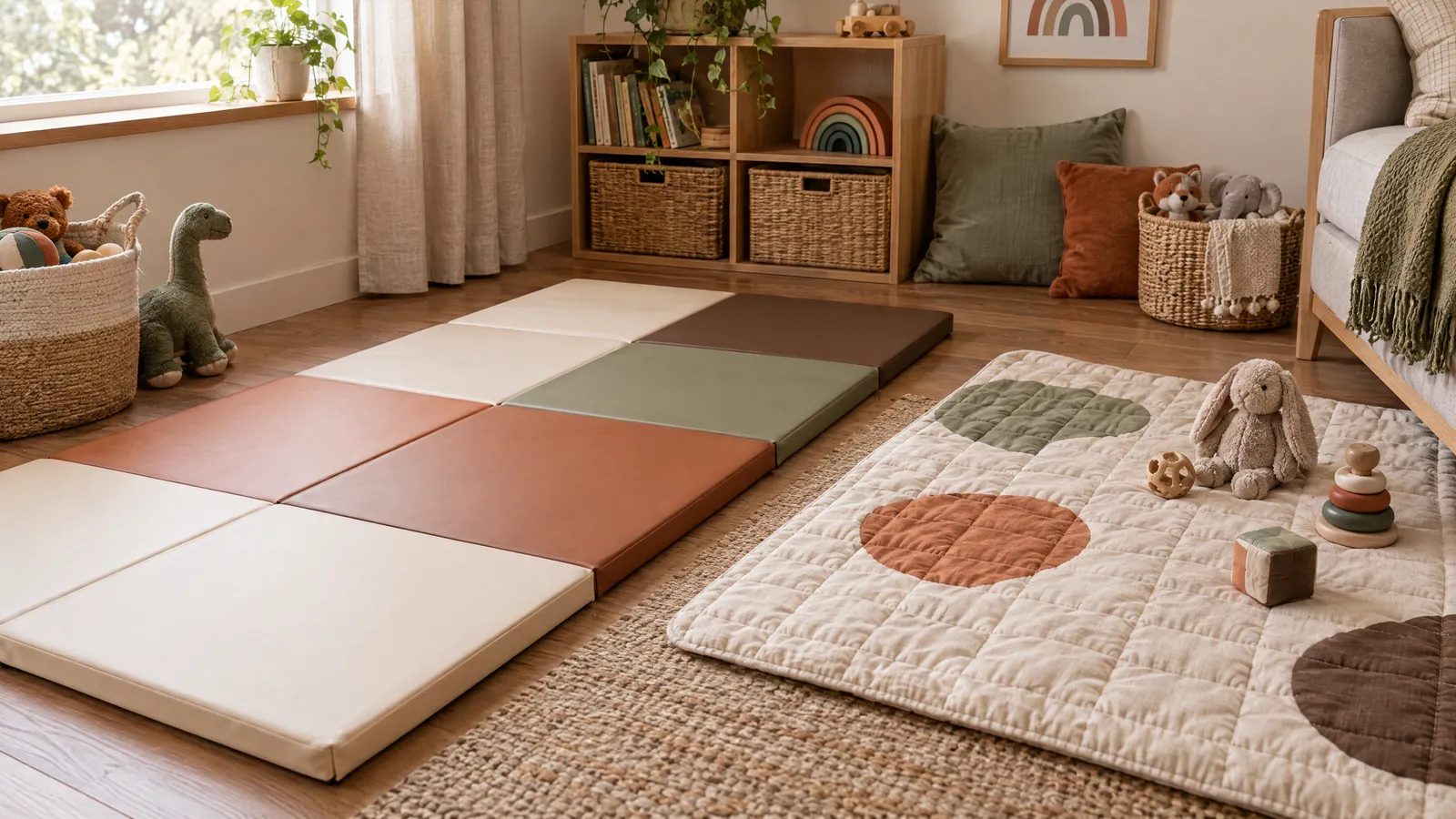
The short answer
Choose a foam play mat if you want more cushioning on a hard floor, a surface you can wipe clean in seconds, and a large area for a crawling baby or toddler. Choose a fabric play mat if you want something soft and light that goes in the washing machine, rolls up small, and looks more like a rug. Whichever you pick, follow the manufacturer’s age guidance, use it for supervised play only, and never use a play mat as a place for a baby to sleep.
Side by side
| Foam play mat | Fabric play mat | |
|---|---|---|
| Common types | Folding panels or interlocking tiles | Padded quilted mats, often cotton or polyester |
| Thickness | Typically about 0.4 to 1 inch (1 to 2.5 cm) | Usually thinner, with light padding |
| Cushioning | More, especially on tile or wood | Less; best on carpet or over a rug |
| Cleaning | Wipe with a damp cloth and mild soap | Machine wash, often on gentle |
| Spills | Water-resistant surface | Absorbs spills until washed |
| Grip on hard floors | Usually stays put | Can slide; may need a non-slip underlay |
| Storage | Folds flat or stacks; still bulky | Rolls or folds small |
| Coverage | Large sizes; tiles can expand or fit odd spaces | Usually smaller, fixed sizes |
| Cost level | Mid-range; large folding mats cost more | Usually cheaper |
When a foam mat is the better buy
Foam makes sense on hard floors. Tile, laminate and wood are unforgiving when a baby who’s learning to sit tips over, and a foam layer adds cushioning between them and the floor.
It also handles mess. Spit-up, milk and snack crumbs wipe off a sealed foam surface, so you don’t need to wash the whole mat after every spill. That matters once your baby is eating solids on the floor nearby.
Size is the other advantage. Folding foam mats cover a large area, and interlocking tiles let you fit an awkward corner or extend the play area as your baby starts crawling. Our guide to baby crawling play mats covers the common sizes and how to measure your floor.
When a fabric mat is the better buy
A fabric mat is the better buy for younger babies and for small homes. Many are designed for tummy time and early floor play, and the soft fabric is pleasant to lie on. They are light, so you can move one from the living room to the bedroom with one hand.
Washing is simpler, too. A fabric mat goes into the machine, which helps when something soaks in. Check the label first: some covers come off a padded insert, while others wash whole.
Fabric mats look like part of the room. In a studio or a shared living space, a quilted mat in muted colors blends in better than bright panels. On a hard floor, put a thin rug or non-slip pad underneath so it doesn’t slide.
Which floor are you covering?
Start with the floor you have. On wall-to-wall carpet, the carpet already adds some cushioning, so a fabric mat is often enough, and it’s easier to lift and wash. On tile, laminate or wood, a foam mat adds more cushioning, or you can put a fabric mat over a rug.
Think about the next stage, too. A small fabric mat suits a young baby who stays in one spot. Once your baby starts rolling and crawling, they move off a small mat quickly, and a larger foam mat or a tile setup covers more ground.
Safety checks for both
Play mats are simple products, but a few checks matter:
- Follow the age guidance. Use the mat for the age range the manufacturer lists, and read any warnings on the packaging.
- Supervise play. A play mat is for awake, supervised time on the floor. Babies should sleep on their backs on a firm, flat surface in a crib or bassinet, never on a play mat.
- Check for loose pieces. Foam tiles often have removable border strips or cut-out shapes. Remove any small pieces a baby could put in their mouth, and replace tiles that are torn or bitten.
- Look for safety certification. Choose a mat that states it meets US toy and children’s product safety rules, with testing by a third-party lab. A children’s product certificate from the seller is a good sign.
- Air out new foam. New foam can have a smell. Unpack it and let it air out as the instructions say before your baby uses it.
In a small space
In a small home, the mat often lives in the living room, so storage decides a lot. A fabric mat rolls up and fits in a basket or under a sofa. A folding foam mat folds into a slim stack that can stand behind a sofa or slide under a bed. Interlocking tiles come apart and stack, but putting them back together every day gets tedious.
Measure the space before you buy. Leave a walkway around the mat, and keep it away from furniture with sharp corners, heaters and cords. Our kids room guide covers soft flooring and storage for small rooms.
Care and lifespan
Wipe foam mats with a damp cloth and mild soap, then let them dry fully. Avoid harsh chemicals and bleach unless the manufacturer says they are safe. Lift the mat every week or so to clean the floor underneath and let it dry, since moisture can get trapped under foam.
Wash fabric mats as the label directs, usually cold and gentle, and dry them completely before use so the padding doesn’t stay damp.
Check both regularly. Replace a foam mat that is cracking, peeling or showing bite marks, and a fabric mat with loose seams or exposed padding.