Renter-Friendly Wall Decor
Decorate rental walls without losing your deposit: how to test adhesives, match hangers to weight, remove them cleanly, and use decor that leans instead.
Before you start
The safest rental wall is one you never stick anything to, so start with what can lean, stand or hang from a door. When you do need the wall, the goal is simple: every hanger matches the weight of the piece, and every adhesive gets tested before it goes somewhere visible.
Read your lease first. Some leases allow a few small nail holes and treat them as normal wear. Others ban anything that marks the wall, including adhesive. If the wording is vague, ask your landlord in writing and keep the reply.
Know your wall. Removable adhesives are made for smooth, painted drywall. They hold less well, and are more likely to pull paint, on:
- Flat or matte paint, which is softer and more porous than eggshell or satin
- Fresh paint: adhesive makers usually advise waiting at least a week after painting
- Textured or bumpy walls, where the strip only touches the high points
- Wallpaper, brick, tile grout and plaster that crumbles
- Bathrooms and walls near radiators, where heat and humidity weaken the bond
Take photos of every wall when you move in. Date them. If a mark was already there, you can prove it.
Gather a small kit: a tape measure, a level, painter’s tape, a pencil, rubbing alcohol, a clean lint-free cloth, a kitchen or bathroom scale, and removable strips or hooks with a printed weight rating.
Step by step
-
Weigh each piece. Small frames go on a kitchen scale. For anything bigger, stand on a bathroom scale holding the piece, then subtract your own weight. Write the weight on a strip of painter’s tape on the back so you don’t have to guess later.
-
Match the method to the weight. Use the weight rating printed on the package and stay comfortably under it, not right at the limit.
- Paper prints and posters: washi tape, poster strips or a clip display.
- Light frames, typically up to a few pounds: removable picture-hanging strips, using the number of strip pairs the package specifies for that weight.
- Anything heavier, any framed glass mirror, and anything above a bed or sofa: lean it, stand it on a ledge, or ask your landlord about proper hardware.
-
Test in a hidden spot. Stick one strip or one decal inside a closet, behind a dresser or low on the back of a door. Leave it for a few days, then remove it exactly as the directions say. If paint comes with it, adhesive is the wrong tool for that wall.
-
Plan the layout on the floor. Lay the pieces out, or cut paper templates to size and tape them up with painter’s tape. A good starting point is to center art about 57 inches (145 cm) from the floor. Over a sofa or console, leave about 8 to 10 inches (20 to 25 cm) between the furniture and the bottom frame, and keep the whole group to about two-thirds of the furniture’s width. Space frames 2 to 3 inches (5 to 8 cm) apart. Our guide to hanging a gallery wall covers grid and salon layouts in more detail.
-
Clean the wall. Wipe each spot with rubbing alcohol on a cloth and let it dry. Household sprays leave a film that stops adhesive from bonding, and dust does the same.
-
Apply and wait. Press each strip firmly for about 30 seconds. Most packages ask you to wait, often about an hour, before you hang anything on it. Mark a level line with painter’s tape so you don’t have to reposition, since lifting a strip and sticking it again weakens it.
-
Put up decals and stickers carefully. Peel off a few inches of backing at a time and smooth from the center outward with a plastic card to push out air. Peel-and-stick mirror tiles need a flat, clean surface; any bump shows as a ripple in the reflection.
-
Remove the right way when you move out. Pull a strip’s stretch tab slowly straight down along the wall, keeping it close to the surface, never out toward you. For decals, warm the edge with a hair dryer on low and peel back at a low angle. Clean any residue with a little rubbing alcohol or mild soapy water, tested in a hidden spot first.
Decor that needs no adhesive
Some of the best rental decor never touches the wall at all.
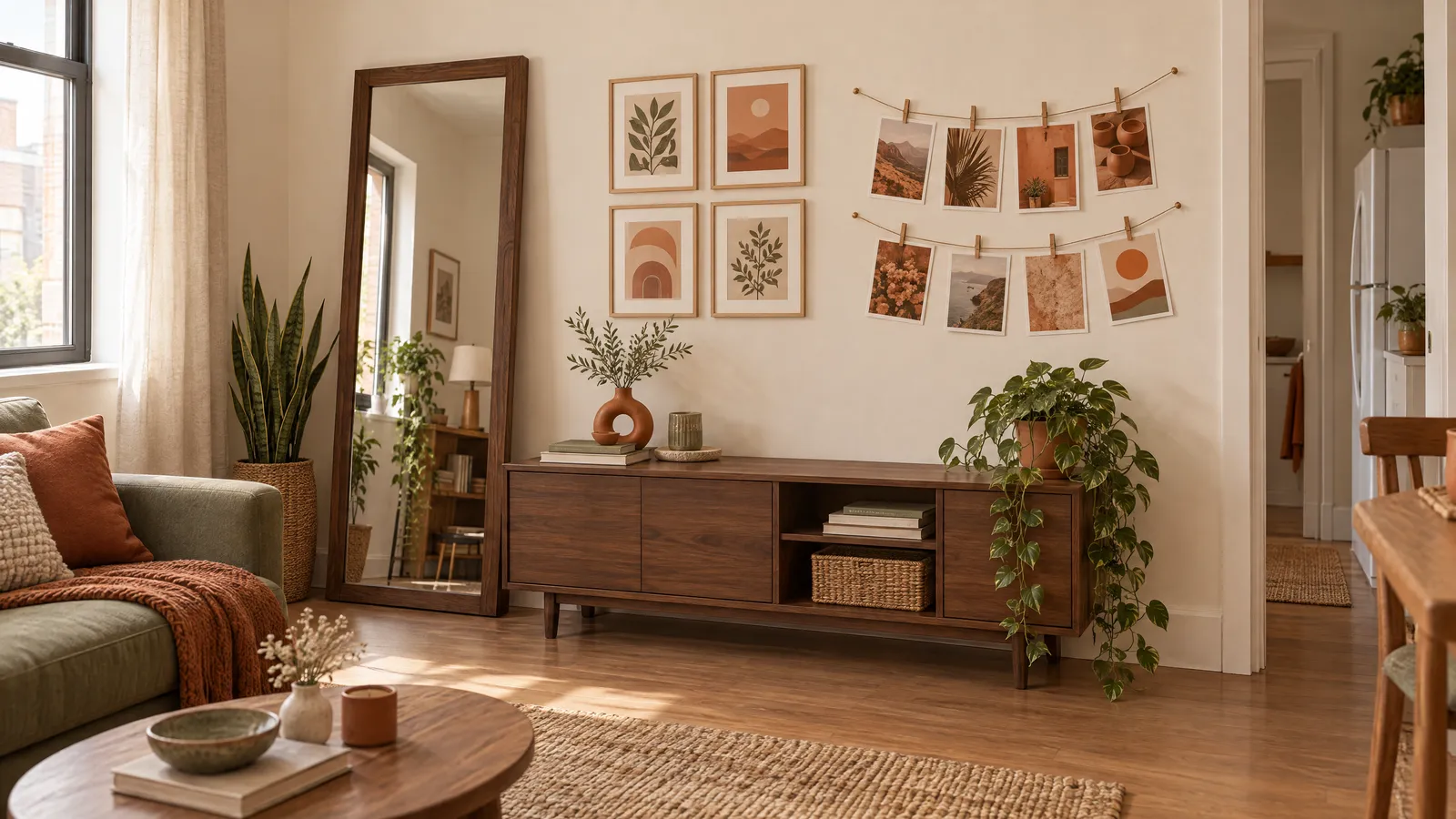
- Lean art on furniture. A dresser, console or deep windowsill holds two or three frames layered at different heights. A narrow picture ledge on top of a low bookcase does the same job.
- Lean a floor mirror. Put a non-slip pad under the bottom edge, angle it only slightly, and keep it out of walkways and away from where children and pets play.
- Use the doors. Over-the-door hooks hold a wreath, a lightweight mirror or a hanging organizer without a single mark.
- String a photo display. A cord with clips weighs very little and needs only two anchor points. Our guide to photo string displays with clips covers lengths and how many prints fit.
- Use tension, not screws. A tension rod inside a window frame or alcove can hold a light textile or a short curtain. Check the rod’s weight rating and the width range it fits.
Small-space tips
Use mirrors to borrow light. A mirror beside or across from a window bounces daylight into a dark room. In a narrow hallway, flat 3D mirror wall stickers or mirror tile wall stickers add reflection without projecting off the wall. If you’re torn between stickers and real glass, our peel-and-stick vs glass mirrors comparison lays out the trade-offs.
Go vertical on slim walls. A column of three small frames fits a strip of wall only 12 to 18 inches (30 to 46 cm) wide, such as the space beside a door frame or between two windows.
Choose one larger piece over many small ones. In a studio, a single big print or mirror reads calmer than a dozen small frames, and it means fewer hangers to remove later.
Keep walkways flat. In a hallway under about 36 inches (91 cm) wide, anything that sticks out more than a couple of inches gets bumped by shoulders and bags, and a bumped adhesive hook is a hook that fails.
Treat the bedroom as a test case. A rental bedroom often has the most blank wall and the least traffic, so it’s a good place to try methods first. Our rental bedroom guide pairs wall ideas with storage that doesn’t need drilling.
Mistakes to avoid
- Going over the weight rating. Ratings assume ideal conditions: smooth paint, a clean wall, room temperature and a piece that never gets bumped. Leave a margin.
- Using fewer strips than the package says. If the instructions call for four pairs on a frame of that weight, three pairs is not close enough.
- Sticking adhesive in the bathroom. Steam and temperature swings weaken most removable adhesives. Use freestanding pieces, over-the-door hooks or suction hooks on glass or tile instead.
- Putting glass mirrors on adhesive. A framed glass mirror is heavy, and a fall is dangerous. Lean it or use proper hardware with your landlord’s permission.
- Pulling strips out toward you. That’s the quickest way to tear paint and the paper face of drywall underneath. Slow and straight down along the wall.
- Using putty on pale paint. Some removable putties can leave greasy marks on light or flat paint. Test first, and avoid it on anything you can’t repaint.
- Hanging over the bed with adhesive. Anything above where you sleep or sit should be very light or properly anchored. A falling frame at night is a real risk.
- Skipping the move-out check. Remove everything a week or two before you hand back the keys, so you have time to clean residue or ask about touch-up paint rather than finding damage on the last day.
Questions people ask
Do adhesive strips damage rental walls?
They can. Removable strips usually come off cleanly from smooth, fully cured paint when you pull the tab slowly straight down along the wall. They are more likely to lift paint on flat or matte finishes, fresh paint, textured walls and wallpaper. Test one strip in a closet or behind furniture for a few days, then remove it exactly as the package directs before you use them anywhere visible.
How much weight can removable hooks hold?
Only what the package says, and that rating assumes smooth painted drywall, a clean surface, the right number of strips and normal room temperature. Weigh each piece, then pick a hook or strip set rated comfortably above that weight, not right at the limit. Humid rooms, textured walls and items that get bumped all reduce how well adhesive holds, so leave extra margin there.
Can I hang a heavy mirror without nails?
Not safely with adhesive alone. A framed glass mirror is heavy and dangerous if it falls, so lean it instead: against a wall on the floor, or on a dresser or console, with a non-slip pad under the bottom edge. Keep it out of walkways and away from children and pets. For a mirror on the wall, ask your landlord about proper hardware, or use lightweight peel-and-stick mirror tiles.
How do I remove adhesive residue from painted walls?
Start gently. Warm the area with a hair dryer on low for about 30 seconds to soften the adhesive, then roll the residue off with your thumb or peel it at a low angle. For what remains, dab with a cloth barely dampened with rubbing alcohol or mild soapy water, then dry the spot. Test any cleaner in a hidden area first, because some paints dull or lift.