Peel-and-Stick vs Glass Mirrors
Peel-and-stick vs glass mirrors compared on reflection, weight, safety, hanging and rental walls, so you know which one suits your space and your lease.
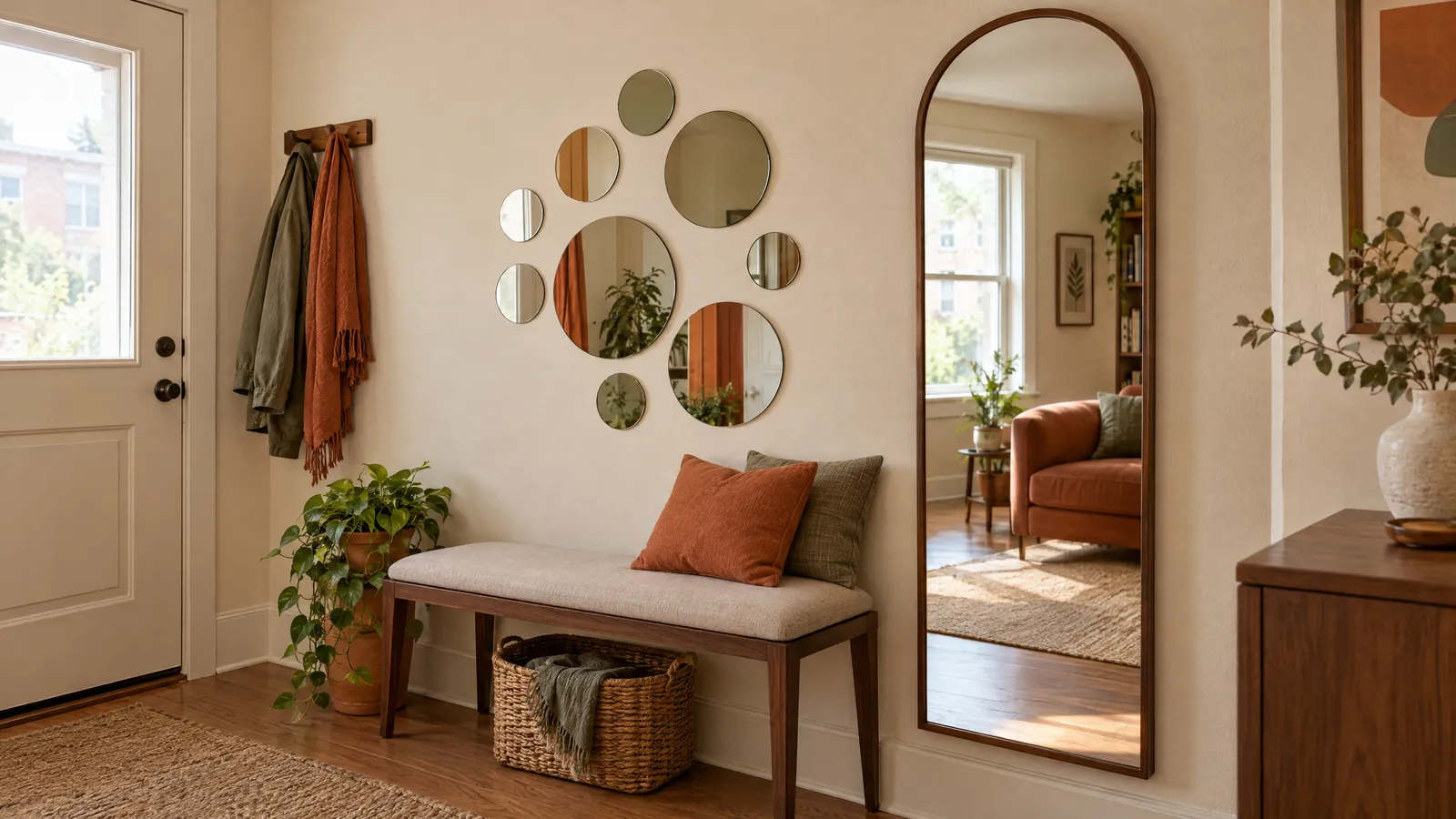
The short answer
Choose peel-and-stick mirrors if you want a decorative accent, a mirror in a child’s room, or something light enough to go up without tools. Choose a glass mirror if you need a true reflection for getting dressed, doing makeup or making a small room look bigger. For anything you actually look into every day, glass is worth the extra weight.
Side by side
| Peel-and-stick mirrors | Glass mirrors | |
|---|---|---|
| Material | Acrylic or plastic film with a mirrored back | Silvered glass, usually 1/8 to 1/4 inch (3 to 6 mm) thick |
| Reflection | Can ripple or warp, especially on uneven walls | Flat and true |
| Weight | Less than half the weight of glass of the same thickness | About 3.3 lb per square foot (16 kg per m²) at 1/4 inch |
| Breakage | Shatter-resistant | Breaks into sharp pieces unless safety-backed or tempered |
| Scratches | Scratch easily | Hard surface, resists scratches |
| Hanging | Adhesive backing on a smooth, clean surface | D-rings, wire, cleat or clips, into studs or rated anchors; or lean it |
| Typical sizes | Small tiles and shapes, often 4 to 12 inches (10 to 30 cm) | Any size, up to full-length and oversized |
| Cost level | Low | Low for small unframed; high for large framed |
| On a rental wall | No holes, but adhesive can lift paint | Small nail or screw holes, usually easy to patch |
When peel-and-stick is the better buy
Peel-and-stick mirrors are decor first. Small acrylic circles, hexagons or strips add sparkle and bounce a little light, and they go up in minutes with no drill. Our guide to 3D mirror wall stickers covers the shaped sets.
They make sense where breakage is a worry: a kid’s room, a narrow hallway where bags swing, or the back of a door that gets slammed. Acrylic can crack if it’s bent hard, but it won’t throw shards the way glass does.
The tradeoff is the reflection. Acrylic is flexible, so any bump or dip in the wall shows up as a wobble in what you see. Stick it only on a flat, smooth, clean surface, press it from the center outward, and accept that it’s an accent rather than a dressing mirror.
Some stick-on tiles are thin real glass on adhesive pads. They reflect better than acrylic but weigh more and can crack. Read the listing to see which you’re getting; our guide to mirror tile wall stickers covers this style.
Before you commit, test adhesive in a hidden corner for a few days. On flat or matte paint, or on paint that’s only a few weeks old, strong adhesive can pull paint off when you remove it. To take one down, warm it with a hair dryer and slide dental floss behind it rather than prying.
When a glass mirror is the better buy
Glass gives a sharp, undistorted reflection, which is what you need for a mirror by the door, a full-length mirror or a bathroom mirror. A large glass mirror opposite or beside a window also bounces daylight deep into a small room in a way a scatter of stickers can’t. Our guide to arched window mirrors covers the tall framed styles that work in entryways and bedrooms.
The cost is weight and care when hanging. At 1/4 inch thick, glass weighs about 3.3 lb per square foot, so a 24 by 36 inch (61 by 91 cm) mirror is around 20 lb (9 kg) before the frame. Hang it from two points, into studs or anchors rated well above that weight, using the weight rating on the package. Never hang a heavy mirror on adhesive strips.
For a close-up view, a magnifying vanity mirror is almost always glass, because magnification needs a precisely curved surface that flexible plastic can’t hold.
Ask about safety backing. Many mirrors have a film on the back that holds pieces together if the glass breaks. It’s worth having on any large mirror, and especially on one that leans on the floor.
In a small space
A big glass mirror is one of the cheapest ways to make a room feel larger. Place it where it reflects a window, a light or a long view, not a blank wall or a cluttered corner.
If you rent, you have three options for glass. Lean a full-length mirror against the wall, with an anti-tip strap or a heavy piece of furniture holding it in place if children or pets are around. Hang it on two picture hooks or screws, which leave small holes most landlords expect. Or use an over-the-door hook mirror. Our guide to renter-friendly wall decor covers more no-drill options.
Peel-and-stick works best in small doses: a strip above a narrow console, or a few shapes beside a light to catch it at night. For a kitchen backsplash refresh, our guide to kitchen wall stickers covers peel-and-stick panels that cope with splashes better than mirror film.
Care and lifespan
Acrylic: clean with a soft microfiber cloth and plain water or a little mild soap. Glass cleaners with ammonia and paper towels can cloud and scratch the surface. Expect it to look its best for a few years; scratches add up and adhesive can loosen in steam.
Glass: spray cleaner onto the cloth, not the mirror, so liquid doesn’t run to the edges. In a steamy bathroom, moisture reaching the silver backing can cause dark spots at the edges over time, so run the fan and dry the mirror’s bottom edge if water pools there. A well-cared-for glass mirror lasts for decades.