Balcony Garden for Beginners
Start a balcony garden: check building rules and weight, map your sun, choose easy plants, pick pots that fit and water them without a hose or drips below.
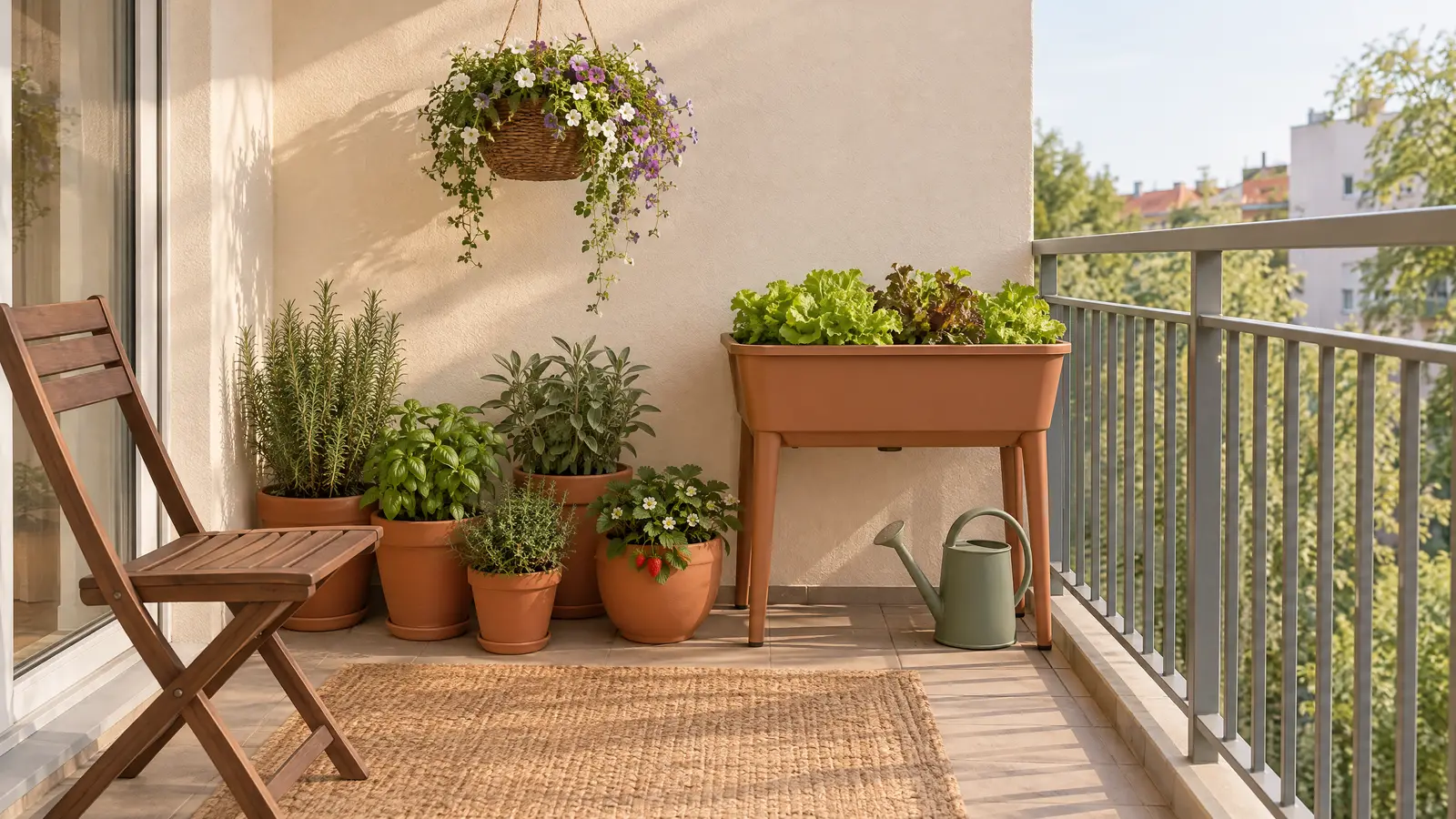
Before you buy a single pot
A balcony garden starts with three checks: what your building allows, how much weight is sensible, and how much sun you actually get. Plants come last.
Read the rules. Many leases and building policies limit what you can put on a balcony. Common rules cover planters on or over railings, hanging items, water dripping onto the unit below, and open flames. Ask your building manager in writing if anything is unclear.
Respect the weight. Wet potting mix is heavy. A 16-inch (41 cm) glazed ceramic pot full of it can weigh 50 pounds (23 kg) or more, and a raised planter full of soil weighs far more than that. You can’t judge a balcony’s load limit by eye, so ask, and until you know, keep large pots few, light and close to the building wall.
Plan for wind. Higher floors are usually windier. Light pots tip, tall plants snap, and anything loose can blow off. Everything should sit inside the railing, never on top of it or hanging outside it.
Think about water. You need a way to carry water to the balcony and a way to stop it running off the edge. A watering can and a saucer under every pot solve most of it.
Step by step
-
Map your sun for one day. Check the balcony at about 9 a.m., noon, 3 p.m. and 6 p.m., and note where direct sun falls each time. Add up the hours. Six or more hours of direct sun counts as full sun, three to six as part sun, and under three as shade. In the Northern Hemisphere, south- and west-facing balconies usually get the most sun, and north-facing the least.
-
Measure the space. Note the floor depth and width, and where the door swings. Keep a clear path at least 24 inches (61 cm) wide from the door to wherever you’ll sit. If you’re thinking about rail planters, measure your railing’s width and check that the bracket’s stated range fits it.
-
Choose three to five easy plants for your light.
Light Easy edibles Easy flowers and foliage Full sun, 6+ hours Basil, rosemary, thyme, cherry tomatoes, strawberries, peppers Geraniums, marigolds, petunias Part sun, 3 to 6 hours Lettuce, spinach, parsley, chives, mint in its own pot Pansies, fuchsias, coleus Shade, under 3 hours Mint and parsley, with smaller harvests Ferns, begonias, impatiens Start with herbs you cook with and one or two flowering plants. One tomato plant is plenty for a first season.
-
Pick pots by size, weight and drainage.
- Herbs: 6 to 8 inch (15 to 20 cm) pots, one plant each.
- Lettuce and greens: a window box or trough at least 6 inches (15 cm) deep.
- Cherry tomatoes and peppers: at least 5 gallons (19 liters) of potting mix per plant, typically a pot 12 to 14 inches (30 to 36 cm) across.
- Strawberries: a strawberry pot holds several plants in one footprint.
- Trailing flowers: a hanging basket planter, from a rated hook and only where your building allows it.
- A small kitchen garden at waist height: a plastic raised planter, after you’ve checked its filled weight against what your building is comfortable with.
Every pot needs a drainage hole. Plastic and fabric pots are the lightest. Unglazed terracotta looks warm but dries out fast in sun and wind. Our ceramic vs plastic planters comparison covers weight and water loss side by side.
-
Use potting mix, not garden soil. Bagged potting mix is lighter, drains better and doesn’t compact in a container the way garden soil does. Fill each pot to about an inch (2.5 cm) below the rim, which leaves room to water.
-
Plant and water in. Set each plant at the same depth it was in its nursery pot, firm the mix around it, and water slowly until a little drains out of the bottom. Put a saucer under every pot before you water.
-
Set a watering routine. Push a finger about an inch (2.5 cm) into the mix; if it’s dry, water. In summer, small pots in full sun may need water every day, sometimes twice in a heat wave. Water in the morning, slowly, at the base of the plant. Empty saucers that are still full an hour later so they don’t overflow onto the balcony below or breed mosquitoes.
-
Feed every few weeks. Potting mix runs low on nutrients within a couple of months. A liquid fertilizer every two to four weeks during the growing season, following the label, keeps herbs and vegetables producing.
Your first-weekend shopping list
Keep the first trip small. For three to five plants you need:
- Potting mix. Bags are usually sold by the quart or the cubic foot. One cubic foot is about 7.5 gallons (28 liters), so a 5-gallon pot takes about two-thirds of a cubic foot.
- A watering can of 1 to 2 gallons with a long spout. Two gallons of water alone weigh about 17 pounds (7.6 kg), so don’t go bigger than you can carry comfortably through the apartment.
- A saucer for every pot, a little wider than the pot’s base.
- A hand trowel and gloves.
- A liquid fertilizer suited to herbs and vegetables.
- Stakes or plant ties if you’re growing tomatoes or peppers.
- An old sheet or drop cloth to pot up on, so spilled mix doesn’t end up in the balcony drain or on the unit below.
Small-space tips
Go up, not out. A hanging basket, a narrow shelf against the wall or a tall strawberry pot adds growing space without taking floor. Keep everything inside the railing and secured against wind.
Group pots together. A cluster of pots shades each other’s sides, holds moisture longer and makes watering one quick round instead of a walk around the balcony.
Use self-watering pots for sunny spots. A reservoir in the base buys you a day or two between waterings in hot weather. Our guide to self-watering planters explains which plants like them.
Put heavy pots on casters. A plant caddy with wheels lets you follow the sun and sweep underneath, but it adds height and weight, so use it only on a level floor.
Harvest little and often. Pinch basil just above a pair of leaves, cut the outer leaves of lettuce and leave the center growing, and pick strawberries as soon as they color. Regular picking keeps small plants bushy and producing.
Plan the whole space. If you want seating, lighting and plants to work together, our balcony garden plan walks through the layout.
Mistakes to avoid
- Buying too much at once. Ten big pots in the first weekend means a lot of weight and a lot of daily watering. Start small and add.
- Pots without drainage holes. Water pools at the bottom and roots rot. If you love a pot with no hole, use it as a cover for a plain plastic pot that drains.
- Planters on or outside the railing. It breaks many building rules and puts people below at risk if a pot falls.
- Picking plants for the photo, not your light. A sun-loving tomato on a north-facing balcony will grow tall and spindly with little fruit.
- Letting water run onto the unit below. Saucers, slow watering and morning timing keep neighbors happy.
- Ignoring wind. Stake tall plants, choose wider-based pots for exposed corners, and bring light pots in before a storm.
- Leaving pots out in a freeze. Wet terracotta and ceramic can crack when they freeze. Empty them or move them somewhere sheltered over winter.
Questions people ask
How much weight can a balcony hold?
There's no single answer, and you can't tell by looking. Load limits depend on how the balcony was built and its condition, so ask your building manager or landlord before adding large planters. Until you know, keep the total modest, use lightweight plastic or fabric pots, place heavier pots close to the building wall rather than the outer edge, and avoid clustering several large pots in one spot.
What are the easiest plants for a beginner balcony garden?
Match the plant to your sun first. With six or more hours of direct sun, try basil, rosemary, thyme, cherry tomatoes and strawberries. With three to six hours, lettuce, spinach, parsley, chives and mint in its own pot usually do well. In shade, ferns, begonias and impatiens are reliable. Start with three to five plants so watering stays manageable while you learn.
How do I water a balcony garden without a hose?
Use a watering can of about 1 to 2 gallons, filled at the kitchen sink. Water slowly at the base of each plant in the morning until a little drains from the bottom, and use saucers so water doesn't drip onto the balcony below. In summer, small pots may need water every day. Self-watering planters and grouping pots together both cut down how often you need to water.
Can I hang planters on my balcony railing?
Check your building rules first, because many prohibit anything mounted on or over the railing. Where rail planters are allowed, use brackets made for your railing's width, mount them on the inside of the rail so nothing hangs over the edge, and fasten them so wind can't lift them. Never hang a planter outside the railing, where a fall could injure someone below.