How to Choose a Bath Rug Set
How to choose a bath rug set for a small bathroom: which pieces you need, sizes that fit, cotton vs microfiber, backings that grip and how to wash them.
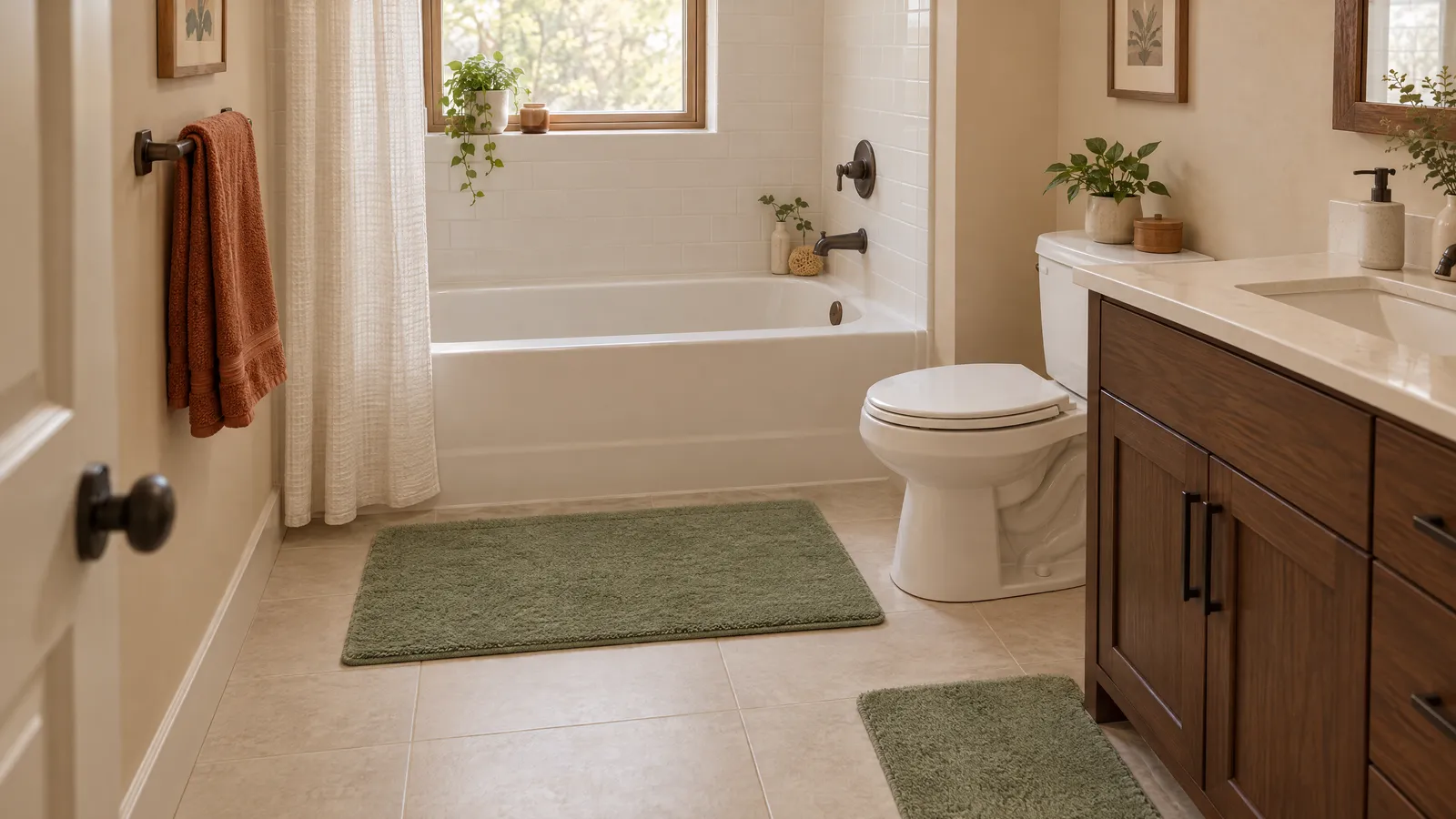
What you actually need
Most small bathrooms need one or two rugs, not three. Start with a mat where you step out of the tub or shower, add a second only if you stand at the vanity long enough to want one, and treat the U-shaped contour rug as optional.
A typical bath rug set comes as two or three pieces: a larger rectangular mat for the tub or shower, a smaller mat for the vanity or toilet, and sometimes a contour rug that wraps around the toilet base. Some sets also add a lid cover. Buying a set gets you matching colors and textures, but only if each piece actually fits the floor you have.
The problems in a small bathroom are predictable. A rug that’s too thick catches the door. A rug that’s too big curls up against the vanity or the toilet. A slippery backing on wet tile is a fall waiting to happen. And a rug that never dries between showers starts to smell within a week or two.
Before you shop, have ready: a tape measure, a note of your floor type (tile, vinyl, wood-look plank, heated floor), and a rough idea of how often you’ll wash the rugs.
Step by step
-
Measure the tub or shower zone. A standard alcove tub is about 60 inches (152 cm) long. Common bath mat sizes are 17 by 24, 20 by 32, 21 by 34 and 24 by 40 inches. For a standard tub, a 20 by 32 or 21 by 34 inch mat covers the step-out area and leaves some tile showing at each end. For a shower stall, measure the door opening and choose a mat a few inches wider than it.
-
Measure the vanity and toilet zones. For a vanity mat, go a few inches narrower than the vanity so the rug sits inside its edges. Typical vanities are 24, 30 or 36 inches (61, 76 or 91 cm) wide, so a 17 by 24 or 20 by 32 inch mat usually suits. For a contour rug, measure from the front of the toilet base to the nearest obstacle, and check the cutout width against your toilet’s base.
-
Check door clearance. Measure the gap between the bottom of the door and the floor wherever the door swings over a rug. The rug’s total height, pile plus backing, has to be less than that gap. Low-profile mats are often around a quarter to half an inch (6 to 13 mm) thick; plush mats can be an inch (25 mm) or more. If the gap is tight, look for flat-woven or waffle-weave rugs.
-
Decide how many pieces you need. Write down each zone and its measurement. If the toilet and vanity sit close together, one mat in front of the vanity may cover both. If a three-piece set includes a contour rug you won’t use, a two-piece set or two separate mats may fit better.
-
Choose the fabric.
- Cotton absorbs well, washes easily and holds up to frequent laundering, but dries more slowly.
- Microfiber and polyester chenille feel soft, absorb quickly and dry faster, which helps in a bathroom with no window or a weak fan.
- Memory foam feels cushioned underfoot but holds water longest, so it suits a well-ventilated room best.
- Waffle-weave cotton is flat, light and quick to dry, and it suits tight door clearances.
Our cotton vs microfiber bath mats comparison goes deeper on drying time and care. For flat, low-profile options, see the guide to waffle bath rugs.
-
Choose the backing.
- Latex or rubber grips well but can crack and crumble over time, especially if it’s tumble-dried hot.
- TPR or silicone-dot backings are flexible grippy alternatives on many newer rugs; check the care label for dryer heat.
- No backing means you’ll want a separate non-slip pad underneath. The guide to non-slip rug mats covers sizing a pad to your rug.
If you have vinyl or vinyl plank floors, be aware that some rubber backings can discolor them over time. Lift the rugs regularly to let the floor dry and check for marks, and follow your floor maker’s guidance on rug backings.
-
Read the care label before you buy. Look for machine-washable rugs that can go in on a cold or warm cycle. Rubber-backed rugs usually need a low dryer setting or air drying. A 24 by 40 inch rug fits in most home washers; anything larger may not wash well in a small machine.
-
Pick a color that hides daily life. Mid-tones such as sage, oat, gray or soft terracotta hide lint, hair and water marks better than pure white or very dark rugs. Matching the rug to your towels, or choosing a shade close to the floor, keeps a small room looking calm.
Small-space tips
One mat may be enough. In the common 5 by 8 foot (152 by 244 cm) full bathroom, the tub, toilet and vanity all line up along one strip of floor. A single mat in front of the tub, sized to stop short of the vanity, often looks better than three small rugs breaking the floor into pieces.
Try a bath runner in a narrow room. In a galley-style bathroom, one long runner, typically about 20 by 60 inches, covers the path from the door to the tub and reads as one surface instead of several patches.
Keep the pile low. A flatter rug clears the door, dries faster and makes the floor look larger. Save plush pile for a bathroom with plenty of clearance and good ventilation.
Give rugs somewhere to dry. After a shower, hang the mat over the tub edge or a towel bar for a few hours, especially in a windowless room. For more ways to manage steam, storage and layout, see our small bathroom guide.
Buy two of the main mat. For a mat that gets used daily, a second one means one can be in the wash while the other is on the floor. Budget-friendly options are covered in the guide to budget bath mats.
Care routine
- Shake rugs out every few days to remove hair and grit.
- Wash every week or two in a bathroom used daily, more often if you have pets or a busy household.
- Wash new rugs separately the first time, since some dyes run.
- Skip fabric softener on cotton and microfiber; it coats the fibers and makes them absorb less.
- Dry on low, or air dry, especially for anything with a latex or rubber backing.
- Replace a rug when the backing flakes, slides or leaves marks on the floor.
Mistakes to avoid
- Measuring the floor but not the door. A rug can fit the floor perfectly and still jam the door every time you open it.
- Hot-drying latex backings. High heat speeds up cracking and crumbling, and once a backing breaks up it stops gripping.
- Leaving a wet rug flat on the floor. Damp fabric starts to smell, and trapped moisture underneath can mark vinyl and wood-look floors.
- Trusting a backing alone on wet tile. No bath rug is completely slip-proof. In a home with young children or older adults, add a grippy pad underneath, keep floors dry, and consider grab bars where your landlord allows.
- Ignoring the edges. A bound or serged edge holds up to weekly washing better than a raw cut edge, which can fray and shed lint in the first few washes.
- Buying a three-piece set for a two-zone room. You pay for a contour rug that ends up in the closet. Check the piece sizes in a 3-piece bathroom rug set against your measurements before you choose one.
Questions people ask
What size bath mat do I need for a standard tub?
A standard alcove tub is about 60 inches long, and most people choose a mat between 20 by 32 and 21 by 34 inches for the front of it. That covers where you step out and leaves some floor showing at each end, which looks tidier. If you have more room and want a longer landing, a 24 by 40 inch mat is the usual next size up.
Do I need the contour rug that comes with a bath set?
No. The U-shaped contour rug that wraps the toilet base is optional, and many people with small bathrooms leave it out. It collects splashes and needs washing more often than the other pieces. If you like a soft spot by the toilet, check that the cutout fits around your toilet's base, since bases vary in width, and that the rug doesn't stop the door from swinging.
Can you put a rubber-backed bath mat in the dryer?
Usually only on low heat or air dry, so check the care label first. Latex and rubber backings can crack, crumble and lose their grip when they are tumble-dried hot, and the flakes end up in your laundry. Shake the mat, hang it over a rail or the tub edge to finish drying, and replace it when the backing starts to break up or slides on the floor.
Are cotton or microfiber bath rugs better?
Cotton absorbs well, launders easily and holds up to frequent washing, but it dries more slowly. Microfiber and polyester chenille feel very soft, absorb quickly and dry faster, which helps in a small bathroom with no window or weak ventilation. Either can work. Choose cotton if you wash rugs often and have good airflow, and microfiber if the room stays steamy or the rug rarely dries between showers.