Cotton vs Microfiber Bath Mats
Cotton vs microfiber bath mats compared on absorbency, drying time, grip, washing and lifespan, plus which mat suits a small bathroom with little airflow.
The short answer
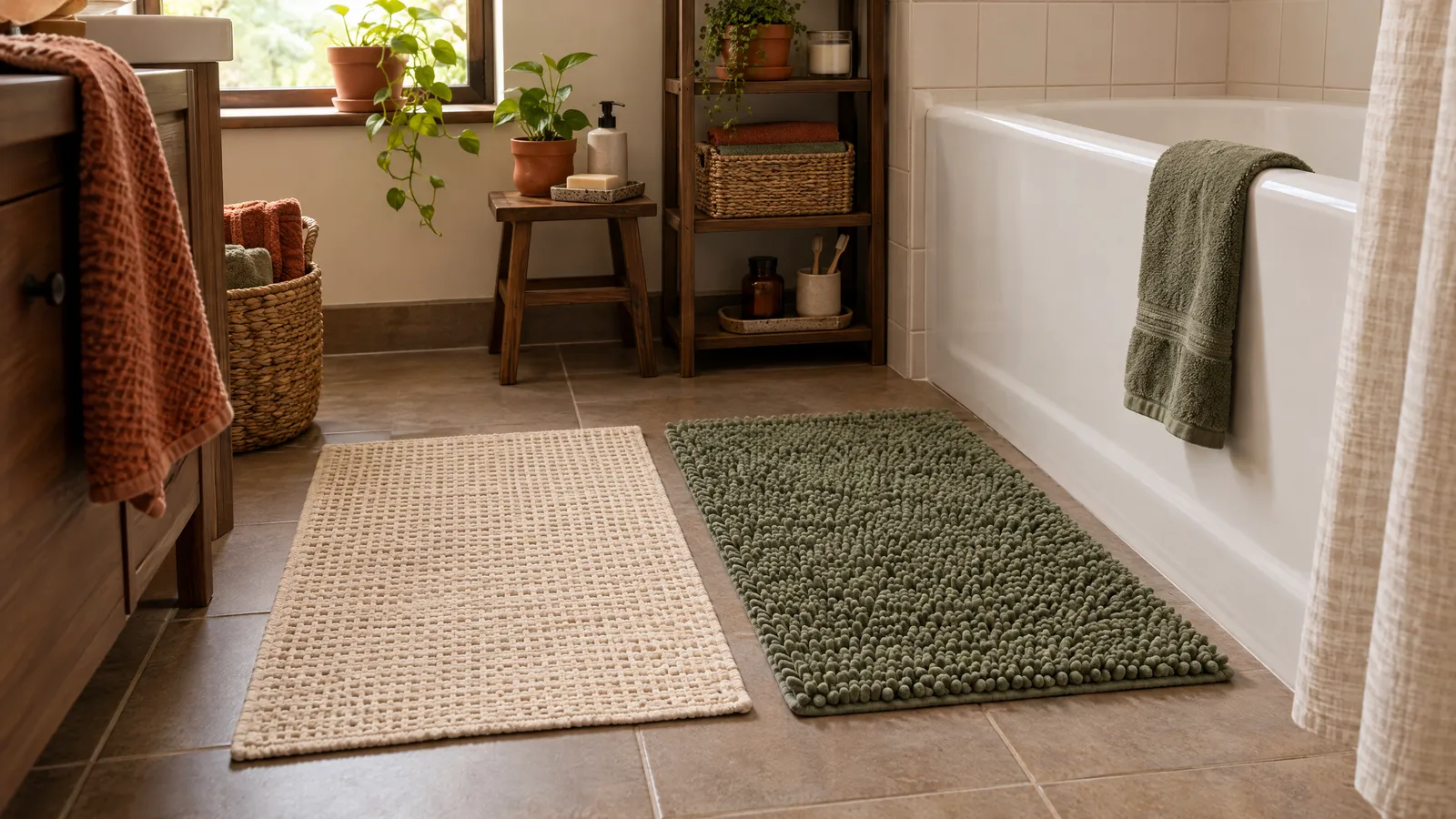
Choose a cotton bath mat if you want a natural fiber that feels soft and solid underfoot, can take hot washes and tumble drying, and your bathroom has a window or a good fan. Choose a microfiber mat if you want something that soaks up water fast, feels plush, and dries quickly in a small bathroom with little airflow. If you share a bathroom and the mat gets used several times a day, microfiber’s fast drying usually matters most.
Side by side
| Cotton bath mats | Microfiber bath mats | |
|---|---|---|
| Fiber | Natural cotton, tufted, terry or waffle weave | Polyester or polyester-nylon blend, often chenille “noodle” or memory-foam top |
| Feel | Soft, flatter, more solid | Plush and springy |
| Absorbency | Holds a lot of water in the fiber | Pulls water off feet fast |
| Drying time | Slower; thick cotton can stay damp for hours | Faster, unless it has a foam core |
| Weight when wet | Heavy | Lighter |
| Backing | Often none, or a light rubber grip | Usually a rubber or latex non-slip backing |
| Common sizes | 17 x 24, 20 x 32 and 21 x 34 inches (43 x 61, 51 x 81, 53 x 86 cm) | Same, plus contour mats about 20 x 20 inches (51 x 51 cm) |
| Washing | Warm or hot wash; tumble dry | Cool or warm wash; low heat or hang dry; no fabric softener |
| Cost level | Low to mid | Low to mid |
When a cotton bath mat is the better buy
Cotton is the classic choice for good reason. It absorbs a lot of water, feels natural underfoot and copes with hot washes, which many people like for a mat they step onto with bare feet. If your bathroom has a window or a strong exhaust fan, the slower drying time is less of a problem.
Weave changes how a cotton mat behaves. A thick tufted mat is the softest but slowest to dry. A flat woven or waffle-weave mat is thinner and dries much faster, and it’s less likely to catch the door. Our guide to waffle bath rugs covers that style.
Many cotton mats have no backing, so they can slide on smooth tile. Put a rug gripper underneath, or see our guide to non-slip rug mats for mats that grip on their own. Cotton may shrink a little in the first hot wash, so buy a mat that fits the space with a little margin, or wash it warm the first time.
When a microfiber bath mat is the better buy
Microfiber is made of very fine synthetic fibers that pull water off your feet quickly and let it evaporate fast. That makes it a strong choice for a windowless bathroom, a shared bathroom, or anyone who wants to step out of the shower onto something plush.
Most microfiber mats come with a rubber or latex backing, so they stay put on tile without a separate pad. Some rubber backings can discolor vinyl or some sealed floors over time, so check the care label if your bathroom has vinyl plank or sheet flooring.
Memory-foam microfiber mats feel the softest at first, but foam holds water and can take a long time to dry. In a damp bathroom, a chenille mat without a foam core usually dries faster.
Budget mats are mostly microfiber, which makes it easy to keep two and rotate them. Our guide to budget bath mats covers the lower-cost options, and our guide to cat bath mats covers a more playful option if you want a mat with some personality.
In a small space
Check the door first. A plush mat can catch a bathroom door that swings inward over it. Measure the gap under the door; if it’s about half an inch (1 cm) or less, choose a thin waffle or flat-weave mat for that spot.
Size the mat to the space you step into. In a small bathroom, a 17 x 24 inch (43 x 61 cm) mat in front of the tub or shower is often enough, and it leaves floor showing, which makes the room look larger. A 20 x 32 inch (51 x 81 cm) mat suits a wider tub front.
Matching sets look tidy in a small room, but they put more fabric on the floor to wash and dry. Our guide to 3-piece bathroom rug sets covers what comes in a set, and our guide to choosing a bath rug set covers sizing each piece. If airflow is poor, you may be happier with one main mat and a bare floor around the toilet.
Hang the mat over the side of the tub or a towel bar after each shower rather than leaving it flat on the floor. That one habit does more for drying than the fiber.
Care and lifespan
Wash bath mats every week or two, more often in a shared bathroom. Shake them out outside first so hair and grit don’t end up in the machine.
Cotton: wash warm or hot and tumble dry, unless the label says otherwise. Mats without backing usually last for years before they thin out.
Microfiber: wash cool or warm and skip fabric softener, which coats the fibers and reduces absorbency. Tumble on low or hang dry, because high heat breaks down rubber and latex backings, which then crack and flake. Replace a mat once its backing starts to crumble, since it no longer grips the floor safely.
For towels to match, see our comparison of cotton and microfiber towels, which covers the same fiber tradeoffs for drying off.