Countertop vs Wall Wine Racks
Countertop or wall-mounted wine rack? Compare capacity, footprint, installation, rental rules and how to store bottles on their side, away from heat.
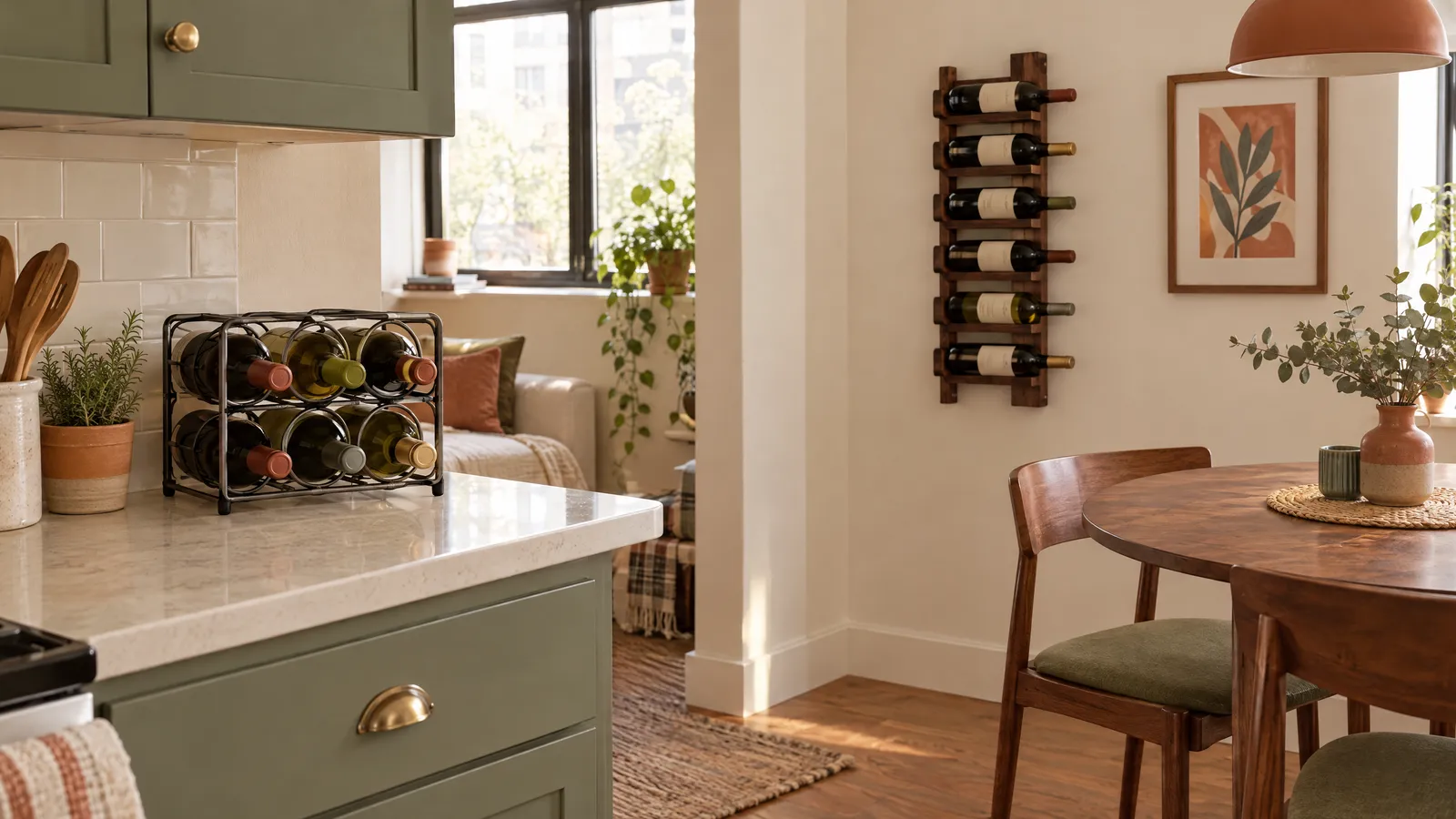
The short answer
Choose a countertop wine rack if you keep a handful of bottles, can spare a corner of counter or shelf away from the stove, and want something you can set up in a minute and move when you move. Choose a wall-mounted rack if counter space is precious, you keep more bottles, and you can drill into a stud or use anchors rated for the weight. Either way, store corked bottles on their side, somewhere cool, dark and steady.
Side by side
| Countertop rack | Wall-mounted rack | |
|---|---|---|
| Typical capacity | About 3 to 12 bottles | About 3 to 20 or more bottles |
| Space used | Counter, shelf or sideboard top | Vertical wall space |
| Installation | None | Screws into studs or rated anchors |
| Moving and renting | Picks up and goes | Leaves holes to patch |
| Load to plan for | Light; sits on the counter | A full 750 ml bottle weighs roughly 3 lb (about 1.3 kg) |
| Bottle fit | Cradles sized for standard bottles | Same; check fit for wide bottles |
| Placement flexibility | Easy to move away from heat | Fixed once mounted |
| Look | Small, freestanding object | Display piece; can read as wall decor |
| Cost level | Usually cheaper | Similar to higher, plus hardware |
How to store wine wherever the rack goes
The rack matters less than where you put it. A few basics apply to both:
- On its side. Corked bottles should lie on their side so the cork stays in contact with the wine and doesn’t dry out. Screw-cap bottles can stand upright.
- Cool and steady. Around 55°F (13°C) is the classic target for longer storage. For bottles you’ll open within a few months, the bigger concern is avoiding heat and big temperature swings.
- Dark and still. Keep wine out of direct sun and away from vibration.
That rules out a few popular spots in small kitchens: the top of the fridge, which is warm and vibrates; the counter beside the oven or dishwasher; and a sunny windowsill. A rack on an inside wall or in a dining corner usually works better.
When a countertop rack is the better buy
A countertop rack is the better buy for small collections. If you keep four to eight bottles that you drink within weeks, a freestanding rack holds them neatly with no tools or holes.
It’s also the renter’s easy option. You can set it on a counter, a bar cart, a sideboard or a bookshelf, and move it if you find it’s too close to a heat source. When your lease ends, it goes in a box.
Our guide to European-style wine racks covers freestanding metal and wood designs, bottle counts and how to check that your bottles fit.
The trade-off is counter space. Kitchen counters are typically about 25 inches (64 cm) deep, and in a small kitchen every foot of prep space counts. A rack that takes the end of a counter or the top of a cabinet you don’t work on is the better plan.
When a wall-mounted rack is the better buy
A wall rack is the better buy when you want capacity without losing a surface. A narrow strip of wall beside a doorway, at the end of a cabinet run or in a dining nook can hold a dozen bottles that would otherwise fill a counter.
It also doubles as decor. Bottles stored label-out on a wall rack read as a display, which helps in a studio where the kitchen is part of the living room.
Plan the mounting carefully, because the load adds up. A 12-bottle rack holds roughly 36 pounds (16 kg) of wine before you count the rack itself. Screw into wall studs where you can, which are typically 16 inches (41 cm) apart in US homes. If you use anchors, choose ones whose package weight rating covers the full load, with room to spare. Adhesive strips and picture hooks are not an option for bottles.
In a small space
In a studio or galley kitchen, the wall usually wins on space, and the counter usually wins on simplicity. Ask two questions:
- Can you drill? Check your lease first. Small screw holes are often easy to patch, but some leases require permission. Our renter-friendly wall decor guide covers what removes cleanly and how to patch.
- Where is the cool spot? Pick the location by heat first, then pick the rack type that fits it.
Check bottle fit before you buy either type. Most 750 ml bottles are about 3 inches (7.5 cm) across and 12 inches (30 cm) tall, but sparkling wine and some wider styles run closer to 3.5 inches and may not fit snug cradles. For more ideas on making one room do everything, see our studio apartment guide.
Care and lifespan
Both types need little care. Dust metal racks with a dry cloth and wipe up drips quickly, since spilled wine can mark wood and corrode some metal finishes. On a wall rack, check the screws once or twice a year and tighten any that have worked loose, and don’t add bottles beyond the stated capacity. Keep bottles turned the same way so you can read the labels without pulling them out.