Cabin vs Dome Tents
Cabin vs dome tents compared on headroom, wind, rain, setup, packed size and real capacity, plus how to store a big tent when you live in a small home.
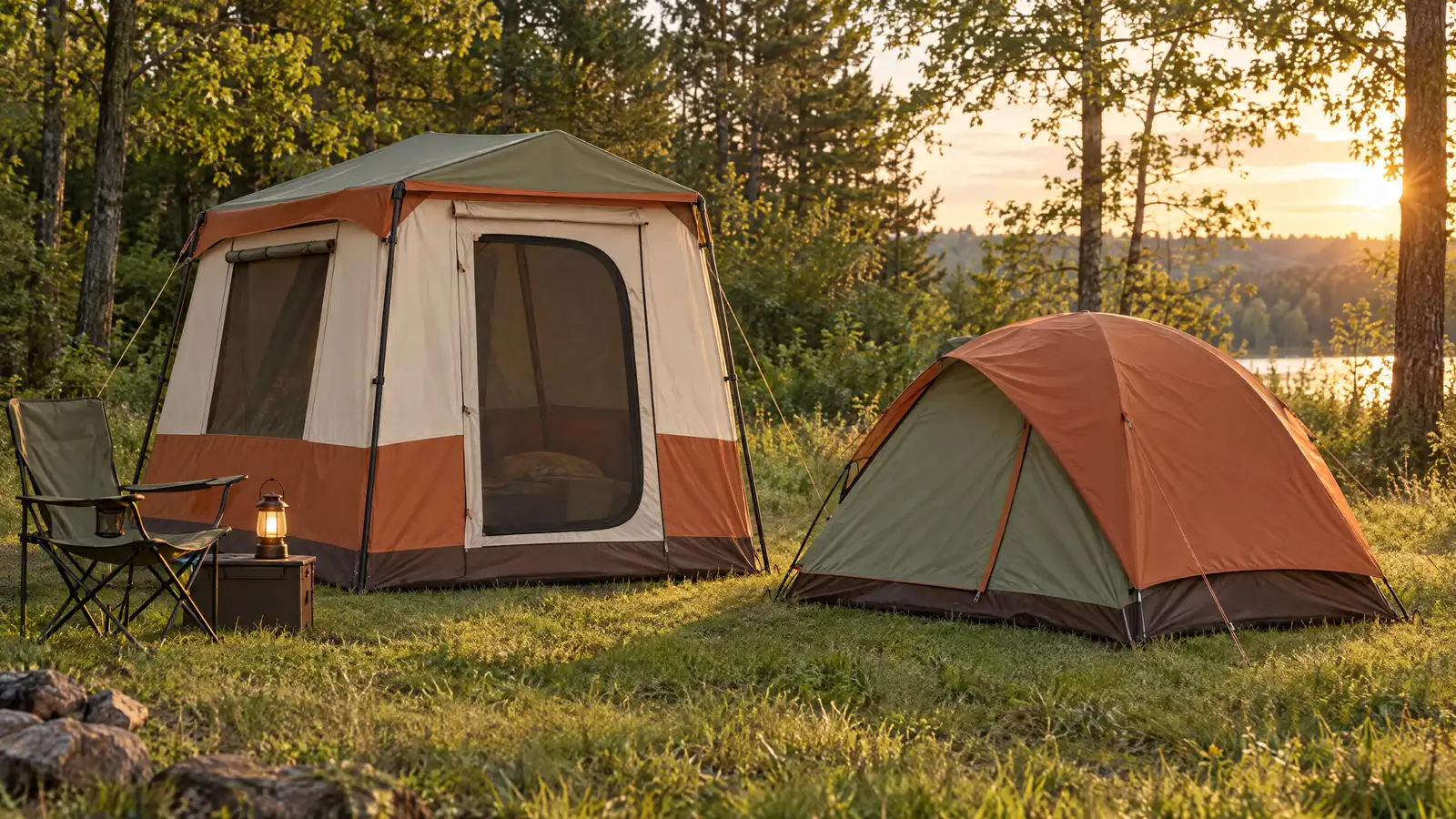
The short answer
Choose a cabin tent for car camping with a family or group, at campsites where you park close by and the weather is mostly fair, when standing headroom and room for cots matter most. Choose a dome tent if you camp in wind or rain, carry the tent any distance, or want something quicker to pitch and smaller to store. If you’ll only camp a few summer weekends a year from the car, a cabin tent is the comfortable pick; for everything else, a dome is the safer all-rounder.
Side by side
| Cabin tents | Dome tents | |
|---|---|---|
| Wall shape | Near-vertical walls | Sloping, curved walls |
| Peak height | Often 6 to 7 feet (1.8 to 2.1 m); most adults can stand | Often 4 to 6 feet (1.2 to 1.8 m) depending on size |
| Usable floor | Almost all of it, right to the walls | Less near the walls, where the roof slopes |
| Wind | Large flat walls catch wind; needs every guyline | Curved shape sheds wind well |
| Rain | Often lots of mesh and a partial rainfly | Often a full-coverage rainfly |
| Packed weight | Heavier; large family cabins are often 20 lb (9 kg) or more | Lighter for the same sleeping capacity |
| Setup | Longer, often easier with two people; instant-frame styles are quicker | Usually quick with two or three crossing poles |
| Packed size | Long, bulky bag | Shorter, more compact bag |
| Cost level | Mid to high | Low to high |
When a cabin tent is the better buy
A cabin tent is about living space. Vertical walls mean you can stand up to change, set up cots or an air mattress against the wall, and still walk around them. Many have a room divider, two doors and wall pockets, which helps a family share one tent without climbing over each other.
They work best at drive-in campsites. Because they’re heavy and bulky, you’ll want the car within a short walk. Our guide to 8-person camping tents covers the sizes and layouts most families look at.
The weak point is wind. A tall, flat wall acts like a sail, so stake every corner and tie out every guyline, even if the evening is calm. If strong wind or a storm is forecast, a cabin tent is the wrong tool, and you should be ready to take it down and shelter in the car.
Check the rainfly too. Many cabin tents use lots of mesh for airflow and a fly that only covers the roof. That’s pleasant on a warm night but lets wind-driven rain in through the sides. Look for a fly that comes well down the walls if your weather is mixed.
When a dome tent is the better buy
A dome is the all-weather default. Two or more flexible poles cross over the top, so wind pressure spreads across the whole frame and the curved walls shed rain. Most come with a full-coverage rainfly and a small vestibule for boots and bags.
Domes are usually lighter and pack smaller for the same number of sleeping spaces, which makes them the choice if you carry gear from a parking lot or plan to use the tent for different kinds of trips. Setup is usually quick once you’ve done it once at home.
The tradeoff is headroom. You’ll kneel rather than stand, and the sloping walls mean the outer edge of the floor is only good for bags. Larger family domes help, but they still lose space near the walls compared with a cabin of the same footprint.
How many people really fit
Tent capacity ratings assume adults lying shoulder to shoulder, usually on narrow sleeping pads with no room for gear. A common rule of thumb is to subtract one or two from the rating: a 6-person tent sleeps four comfortably, and an 8-person tent suits four to six. If you use cots or a queen air mattress, compare the mattress size with the floor plan rather than trusting the number.
Check the footprint against the space you’ll pitch on. Large family tents are often 10 feet (3 m) or more on a side, plus several feet more for guylines, and some campsite pads are smaller than that.
In a small space
Storage is the small-home problem with any big tent. A cabin tent bag is often long and heavy, so measure the closet floor, the space under the bed or the shelf in a storage unit before you buy.
Always dry a tent completely before you put it away. Packing it damp causes mildew and a smell that doesn’t wash out. In an apartment, hang the body and fly over a shower rod, across chairs or on a balcony railing for a day, then pack it loosely. Storing it in a larger breathable bag, rather than rolled tight in the stuff sack, is easier on the coating.
Practice the setup once at home if you can: a park, a yard or even a large living-room floor for the inner tent. You’ll find missing stakes before the trip, not at dusk. For more outdoor gear chosen with small homes in mind, browse our planters, garden and outdoor guides.
Safety and care
Never use a heater, stove, grill, fuel lantern or anything that burns fuel inside a tent or its vestibule. They can cause a fire and produce carbon monoxide, which builds up quickly in a closed tent. Use battery-powered lanterns and warm bedding instead. Keep the tent well back from the campfire and upwind of it; at least 15 feet (4.5 m) is a common rule of thumb, because sparks melt tent fabric.
After a trip, shake out dirt, spot-clean with a sponge and water rather than a washing machine, and let it dry. Store it out of direct sun and away from heat. Look over seams, zippers and poles each season, and reseal leaking seams before they let water in. A tent that’s dried and stored well typically lasts many seasons.