Plastic vs Fabric Storage Bins
Plastic vs fabric storage bins for small homes: which handles damp, dust, stacking and daily use, with sizes, care tips and where each one belongs.
The short answer
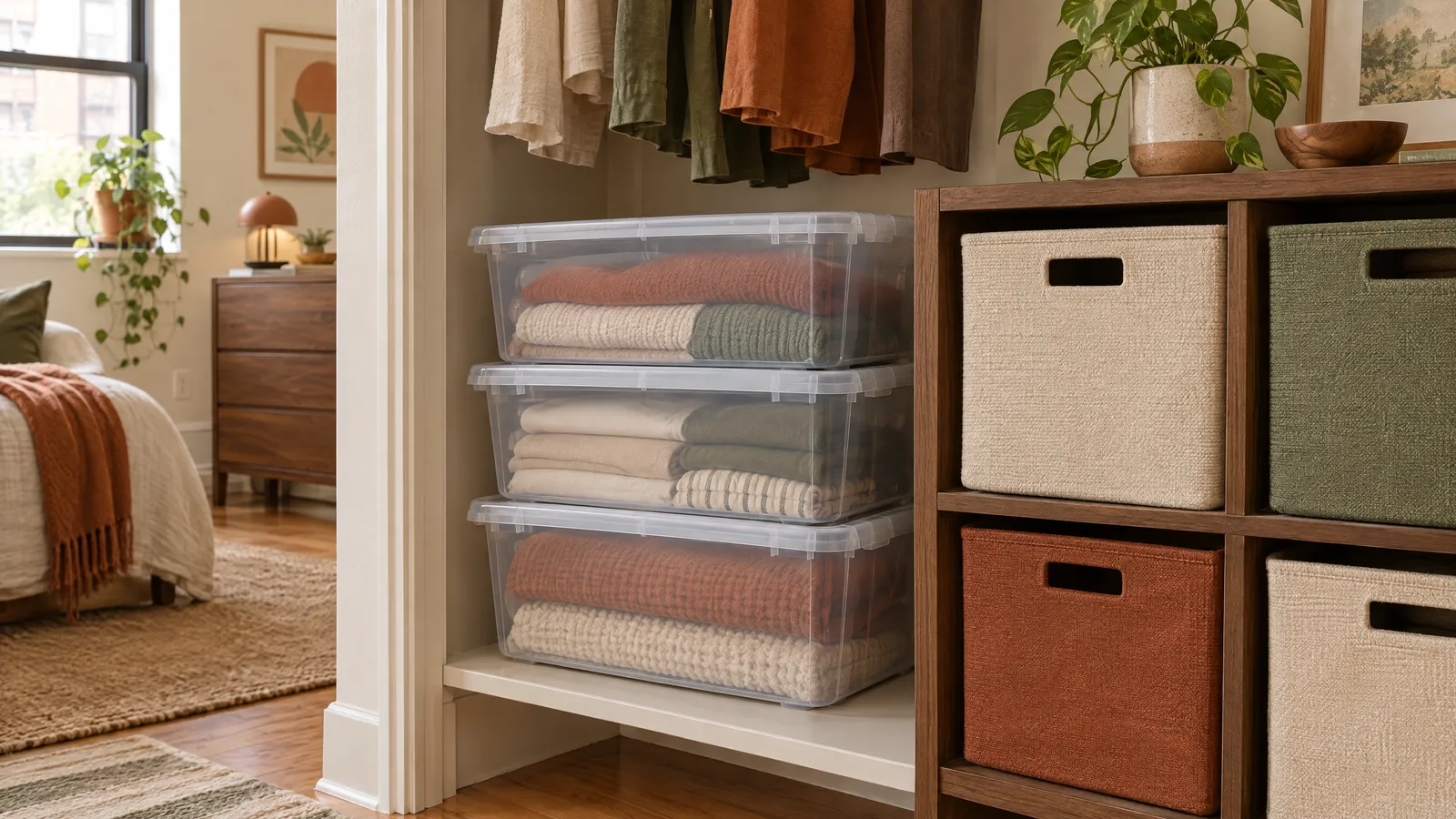
Choose plastic bins if the contents need protection from damp, dust or pests, or if you need to stack boxes three or four high in a closet, under a bed or in a storage unit. Choose fabric bins if they sit on open shelves or in a cube unit where you reach into them every day, and you want them to look soft and fold flat when empty. Most small homes end up with both: plastic behind closed doors, fabric where people can see it.
Side by side
| Plastic bins | Fabric bins | |
|---|---|---|
| Empty weight | Usually under 1 lb (0.5 kg) for a shoebox size, 2 to 4 lb (1 to 2 kg) for a large tote | Usually under 1 lb (0.5 kg) for a standard cube |
| Damp and dust | Lidded bins keep out dust and splashes; latching or gasket lids seal best | Absorbs damp and collects dust; not for basements, garages or under sinks |
| Stacking | Lidded bins typically stack 3 to 5 high when full | Won’t stack on their own; needs a shelf or cube unit |
| Visibility | Clear plastic shows contents at a glance | Opaque; needs a label or a front window |
| Typical sizes | Shoebox (about 6 quarts) up to 60-plus-quart totes; under-bed boxes about 6 inches (15 cm) tall | Cubes usually 10.5 to 13 inches (27 to 33 cm) to suit cube shelving; open baskets in many sizes |
| Care | Wash with warm soapy water | Vacuum or spot-clean; many can’t go in a washer because of the board inserts |
| When empty | Lidless bins nest; lidded bins take their full space | Fold flat |
| Cost level | Low to mid; clear latching bins cost more | Low to mid; lined or woven styles cost more |
| Best small-space spot | Closets, under beds, high shelves, under sinks | Open shelving, cube units, nightstand cubbies |
When plastic bins are the better buy
Plastic earns its place wherever conditions are less than ideal. In a basement, garage, storage unit or the back of a closet on an outside wall, a lidded bin keeps out dust, moths and the occasional leak far better than fabric can. If a floor floods even an inch, contents in fabric are usually ruined; plastic with a lid usually survives.
Clear bins matter more than people expect. When you can see what’s inside through the side, you stop pulling down three boxes to find one. For long-term storage, pick lids that latch or clip; loose lids pop off when a stack shifts.
Plastic is also the answer under the bed. Flat and rolling under-bed boxes are usually about 6 inches (15 cm) tall, so measure the clearance under your frame first and leave at least half an inch (1 cm) to spare. Our guide to plastic organizer boxes covers the smaller divided boxes for drawers, craft supplies and bathroom cabinets.
Two caveats. Thin, cheap plastic can crack in the cold and turn brittle in sun, so choose thicker bins for a garage or attic. And never seal damp things in a closed bin: trapped moisture means mildew. Make sure clothes, bedding and paper are completely dry first.
When fabric bins are the better buy
Fabric bins are for things you use, not things you store. On an open shelf or in a cube unit they hide visual clutter (chargers, toys, scarves, cleaning cloths) and soften a room in a way a row of plastic doesn’t. You pull one out like a drawer, grab what you need and slide it back.
They are light, so they are safe on high shelves and easy for children to handle. They fold flat when you don’t need them, which matters in a small home with no spare closet to hold empty containers.
Measure the shelf opening before you buy: height and depth as well as width. A bin half an inch too tall won’t slide in, and one that’s too shallow leaves a gap that looks untidy. Closet shelves are often about 12 inches (30 cm) deep, which suits most standard cube bins. Our guide to narrow closet shelves shows how fabric bins pair with slim shelving.
Skip fabric for anything damp, oily or fragile. Wet swimwear, sponges and anything that lives near a sink belong in plastic. Fabric isn’t crush-proof either, so heavy contents make the sides sag and the bin hard to pull out.
In a small space
Think in zones. Behind closed doors, under beds and on high closet shelves, plastic wins because it stacks and protects. Anywhere you can see the storage, fabric usually looks calmer and sits flush in cube shelving.
Under a bathroom or kitchen sink, use plastic only: pipes drip and cleaning products leak. Our guide to under-sink organization ideas covers sizing bins around the plumbing. For a wardrobe, our guide to organizing a small closet walks through which shelf gets which kind of container.
Match sizes across a shelf. A row of identical bins looks tidier than a mix, and same-size boxes stack safely. Buying one size in a larger quantity also keeps your options open when you rearrange later.
Label everything you can’t see into. A strip of masking tape and a marker is enough; on fabric, a clip-on tag works. The point of a bin is finding things, not just hiding them.
Care and lifespan
Plastic bins usually last for years. Wash them in warm soapy water, dry them fully before refilling, and keep them out of direct sun, which fades color and makes plastic brittle. Check lid clips and handles once a year; they tend to wear out before the box does.
Fabric bins wear faster. Vacuum them with a brush attachment, spot-clean with mild detergent and let them air-dry, with the stiffening board taken out if it slides free. Many are spot-clean only because the board won’t survive a washer, so check the care label before you try. Expect a few years of daily use before seams or handles give way, sooner if they’re overloaded.
Either kind is cheap, so the real cost is buying the wrong size twice. Measure the shelf, the closet and the gap under the bed first, then buy.